.png?width=200&height=58&name=Primary_White_XYCLE_Logo.png-09%20(2).png)
Life Cycle Assessment (LCA) is the foundation of how XYCLE works. Whether you are a sustainability professional, a supplier, or simply someone providing data into the platform, understanding the basics of LCA will help you use the tool more effectively and interpret your results with confidence.
Beginner’s Guide: The basics of LCA
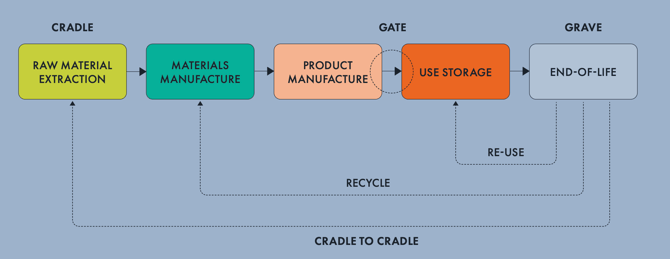
An LCA measures the environmental impacts of a product, service, or process over its entire life cycle or just part of it. This could mean looking at the journey from raw material extraction to disposal (cradle-to-grave), or focusing only on the stages up to the product leaving the factory or other part of the supply chain (cradle-to-gate).
LCAs break down impacts into categories such as climate change, water scarcity, land use, and resource depletion - but there are 16 in total for a standard LCA. This makes it possible to see where the greatest environmental effects occur and to target improvements.
It should be noted that there is also a more specific type of LCA into climate change impact known as a Carbon Footprint of a Product (CFP).
Advanced Detail: Deeper into the methodology
Experienced practitioners will recognise that LCA is guided by ISO 14040/44 standards, while CFP is guided by ISO 14067.In XYCLE, the Environmental Footprint (EF) methodology is used, which is a midpoint approach recommended by the European Commission. This methodology evaluates environmental impacts at an intermediate stage in the cause-effect chain, which allows for a more nuanced interpretation before results are translated into potential damage categories.
You can set different system boundaries such as cradle-to-gate, cradle-to-grave, or gate-to-gate. The choice depends on the level of control or influence you have over each stage of the process.
In XYCLE: Applying LCA concepts
When you create a project in XYCLE, the scope and boundaries you choose will determine:
-
Which datasets are pulled in (foreground and background)
-
Which life stages are included in the results
-
How you interpret hotspot and contribution charts
By making deliberate choices at this stage, you set yourself up for results that are both accurate and relevant to your business needs.
Next Steps Checklist
- Decide whether your study needs full life cycle coverage or a more focused scope
- Review which stages you have reliable data for and which will require background data
- Set your project’s boundaries in XYCLE before entering any process data